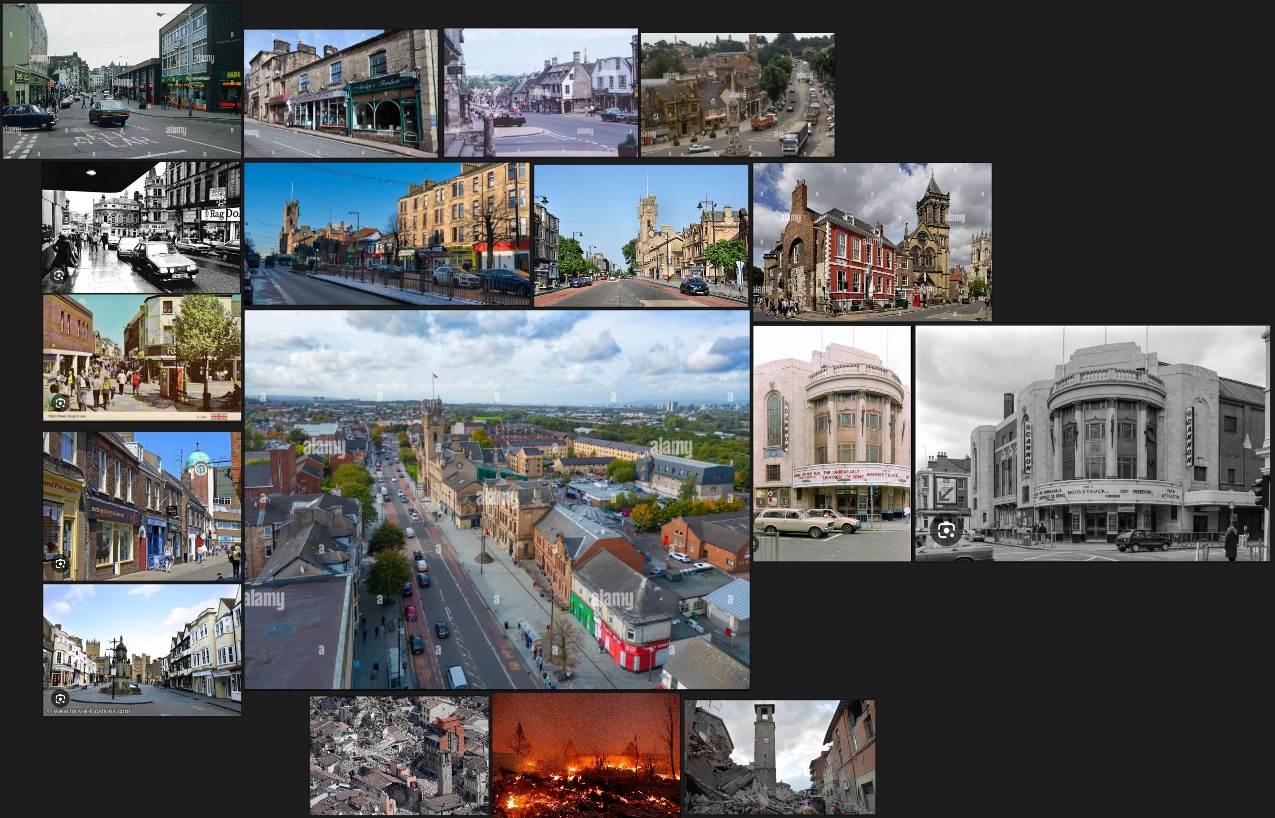
The project is about a British rural town that was destroyed by an earthquake, I was responsible for the level design blockout of this level.
The references must be from 1980’s British rural towns (with a focus on the town center) featuring a few select landmarks, like a church, a cinema, etc.
There will be signs of a huge earthquake. Collapsed buildings, chasms and fissures on the ground. At the center of town, there’s a large pit on the ground, a huge mutated boss will spawn from this hole, revealing it is the cause of the earthquakes.
The idea for player progression is he spawns in the outskirts and walks their way towards the pit. Almost like layers, the outer ring serving for players to get used to gameplay and gear up. The next ring to further gear up and prepare for the center boss fight.
The town was to be designed in a way that makes sense, with a scale favoring horde looping type games, meaning it would be fairly condensed, but also interesting to play through with blocked off streets, verticality, etc. The interiors of shops and buildings were up to me, only the cinema, the church and the arcade should definitely have one.
My Approach
I like to start working directly in the engine, so I split the task into 3 parts. First I developed the overall layout and composition of the town. Starting with what are the streets diameters, how the town could fit the main landmarks and still be condensed, and how a rural town in England would behave.
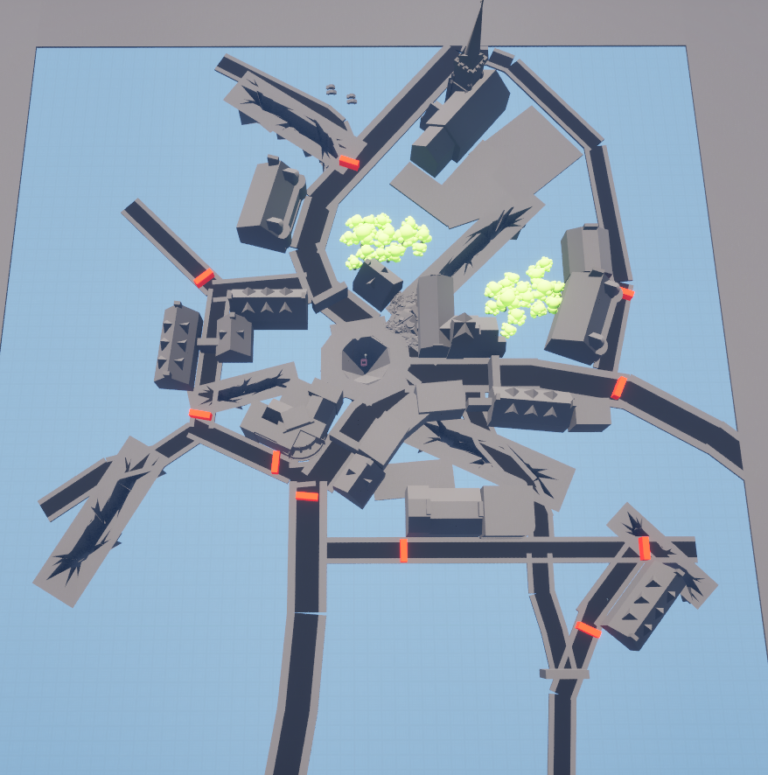
This was the design I came up with. Featuring the main roads that normally are larger for the town center, and the smaller roads leading outwards towards more residential areas. The main landmarks are positioned in a structure of gameplay areas between them and the blocked roads that will limit the playable area are mostly defined but subject to changes. The Pit in the center is where it all started, since it was easier to design around it. This is the part where usually some designer like to make on paper and brainstorm this way. This first overall composition allowed me to make sure all large changes would be made and align with the features and requirements before committing to heavier polishing on areas that could change later and still already have a starting point designed in engine.
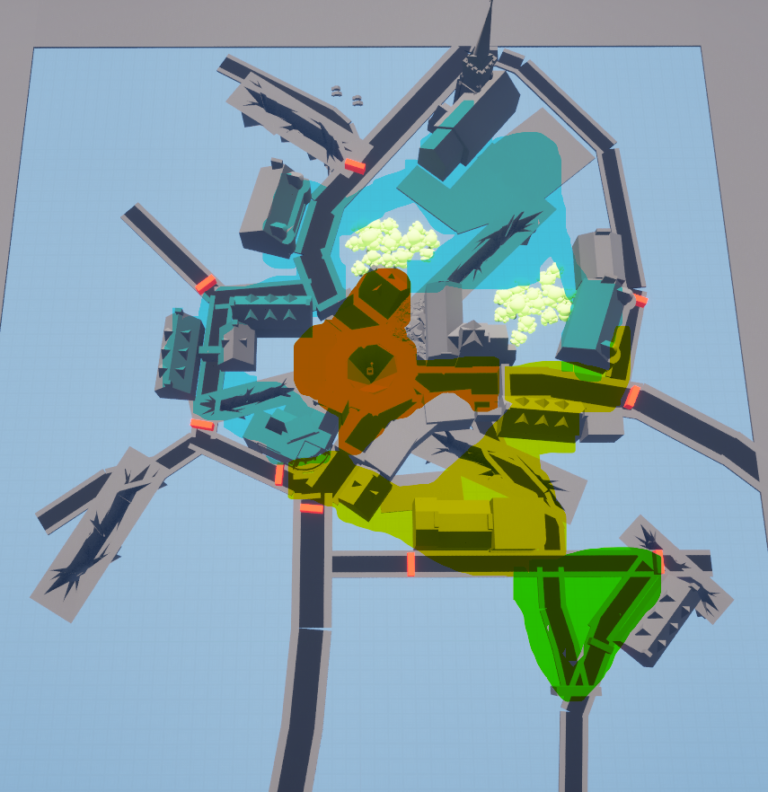
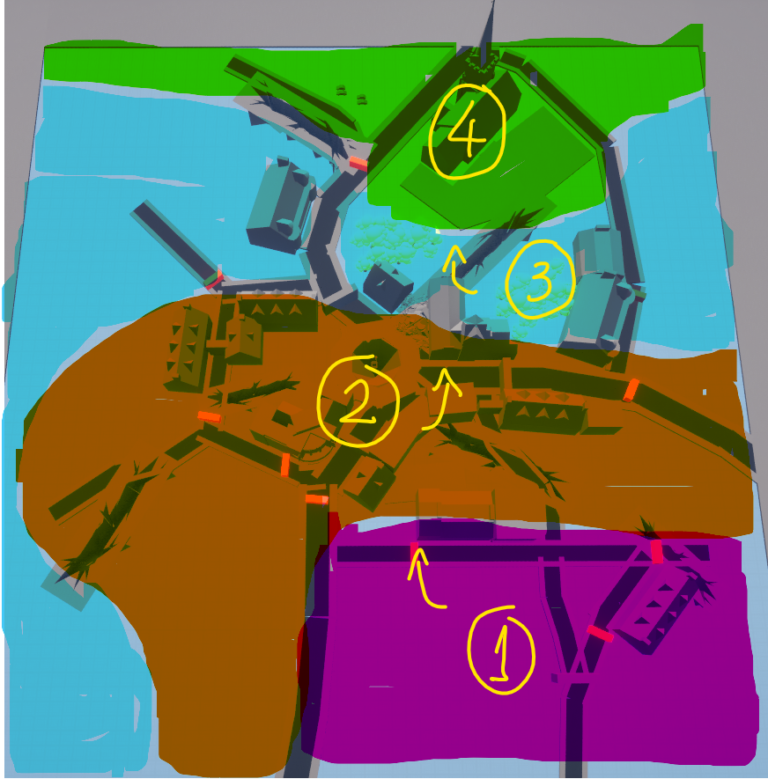
An overview of how the Zones of the town would be, starting in the Outer Zone (green) and making its way towards the center (orange).
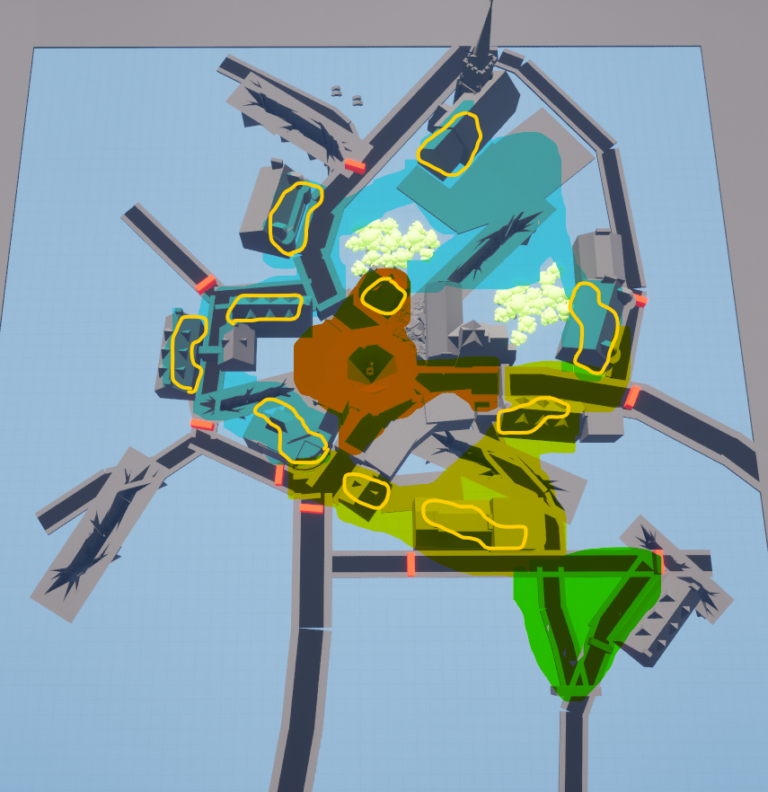
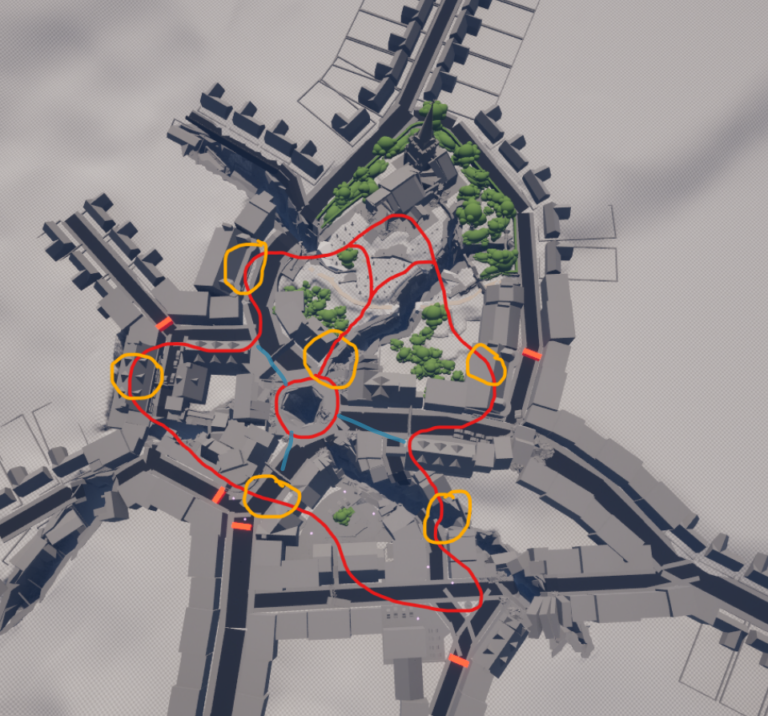
Highlighting the possible buildings that would have an interior (in yellow), allowing me to have an idea of layout and pacing.
A description of how the Terrain elevation would look like, with the lower area being "1" and the higher area being "4". Using it to add verticality and composition, like the church usually being built on elevated areas in the real world.
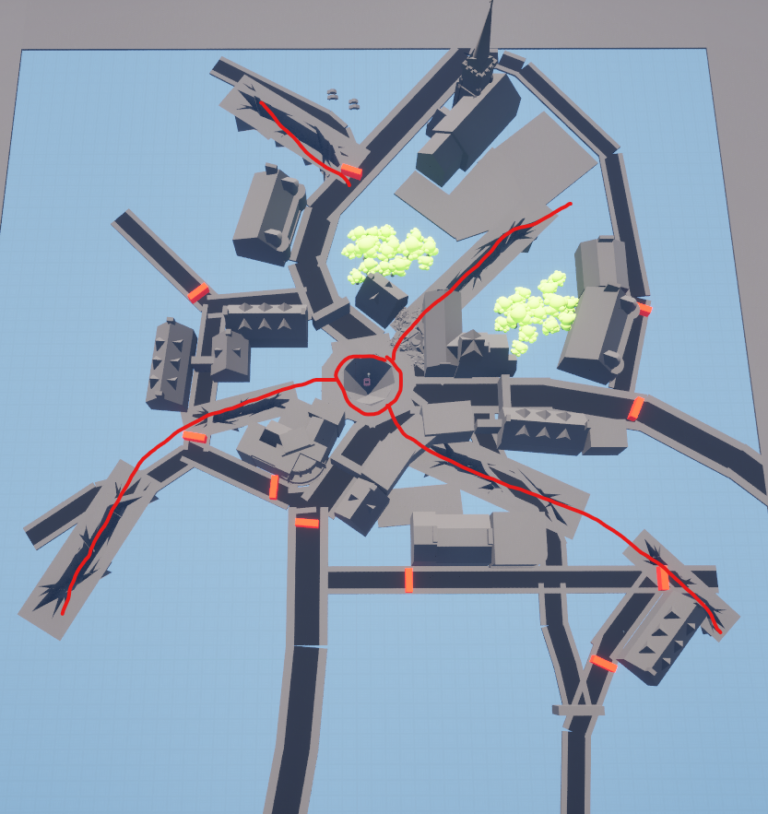
Taking fissures of the earthquake into consideration. I made sure to align most of them with the large pit in the center where the boss will appear, adding some sense and depth to the fissures around town.
After the first part of the Overall blockout. I started the design of the path of the player. Which meant connecting the Starting point of the player to the final boss with the gameplay area.
The main necessary features relevant for this stage of development are:
Places to hold off enemies/camp
Areas to place mission NPCs
Areas of Interest (e.g shop interiors that allow for shortcuts)
Areas that will enable the black market trader (gun shop) to be placed at different locations around the map (like killing floor)
Almost a circuit-type design that traditionally works with horde-mode games
It starts with some polish around the walkable area to have a grasp of the time it takes to walk, where verticality will add depth to gameplay, where the composition of the level will help players see where to go and where loopable areas fit the setting. It also means enhancing the architecture, mainly the landmarks, because their shape would influence their surroundings and consequentially the player path towards it, not to mention that doors and hallways will deliver an experience to the player, being it tight or open and if the entrances and exits frustrate the player or not.
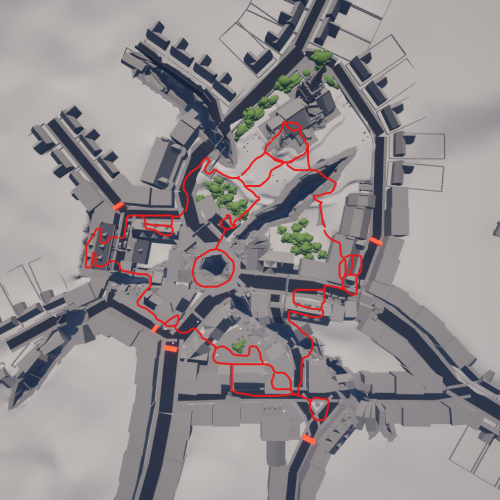
Initial Player path development.
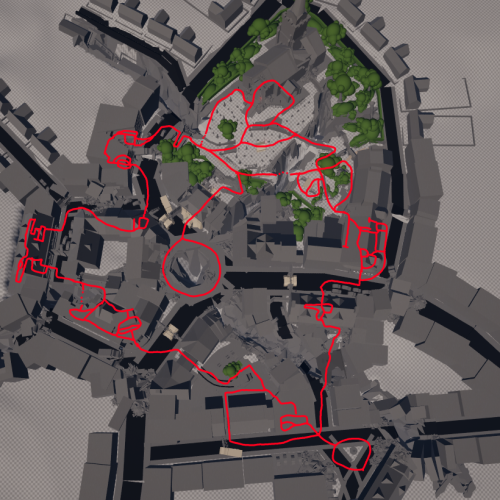
More advanced Player path development.
The interiors play a major role on this second part of development, they are used for shortcuts, tasks completion and gameplay in general.
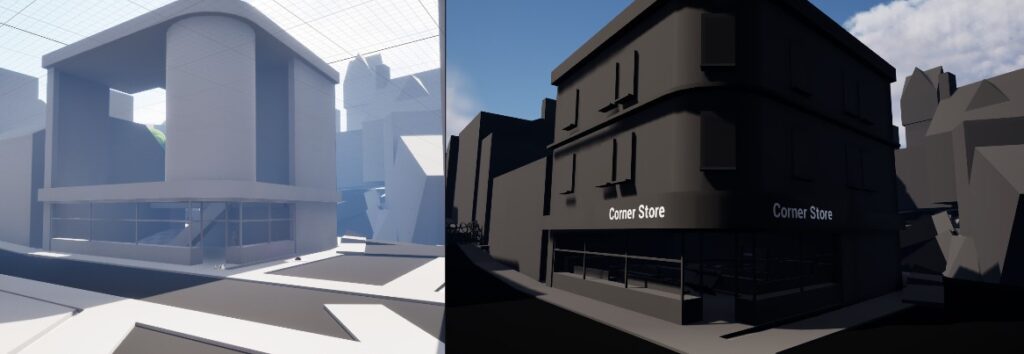
Development of the Corner Store, one of the buildings with an interior present in the level.
Speaking of which, the zones of the level will be gated by some tasks the player must complete to advance further into town. These tasks will trigger hordes of enemies and the player must hold them off.
I knew there had to be some gameplay area before a given task was introduced, so I arranged 6 tasks in total being fairly apart from one another, giving breathing and playable space, also know as pacing, between them. 5 of them will be around the town and allow players to cross between the zones, giving them a large ring around town as a playable area to manage enemies and quests. The sixth task in the middle is a specific one that the player will be able to unlock to go towards the boss arena in the center around its large pit. After the player defeats the boss (or an easter egg is completed, it was still not defined) the player would earn a keycard that would allow him to cross between the zones using the barricaded paths towards the middle zone (paths in blue in the image below). This will give the player not only a huge ring around town as before, but now have 3 big loops and be able to choose where to proceed with more options.
The environmental storytelling started taking final shape in this section as well. Some parts of the environment that will heavily influence the path of the player needed more clarity to become something meaningful of production, so I like to give some sense of what “something” is so the art team and production can understand the idea better. The cross team communication is essential through development, the producer and the artist agreed with the high quality result of the level design and the attention to detail the environmental storytelling gives them.
*Images of roads with environmental storytelling, etc.*
The final part of development is heavy playtesting and polishing of playable areas to refine movement and constraints the player may have during gameplay. Although I playtest during the other initial parts as well to have a better idea of movement, metrics and overall gameplay. This part takes it more intensely and becomes even a bit repetitive, because we can’t perceive bottlenecks and other things that can only be seen when playing, so a lot of playtesting is the way.
Some rough shapes blocking the way over here, some paths that should be blocked over there. That’s the core of this section. I placed blocking volumes where players must absolutely not go (and the environment did not already block), like some rubble that prevents the player from going that direction, but if he insists, the character movement may allow to have “cheats” towards overcoming the rubble, so I place blocking volumes there to prevent it. I updated collisions on the walk path that gave clear perceptions of movement disruption and polished them to a non perceptive or disruptive walkable state.
I added enemies spawn points (subject to heavy change after art pass) and made them have some sense around the town. Mainly 3 categories: Crawling from under something: like under a car, rubble or a vent Falling from a higher ground: like a point where player’s can’t reach but enemies can fall to the playable area Climbing through lower ground: like an unreachable point to the player below, for example, the fissures
The full implementation of all mechanics was not complete, but this type of design can still be made without the functioning features and still give a heads up on what can be used on the final game.
It is ideal to also have playtesters after this part to further enhance the level design and make sure everything clicks to the desired outcome. There was no playtesting planned at the moment for this project.